
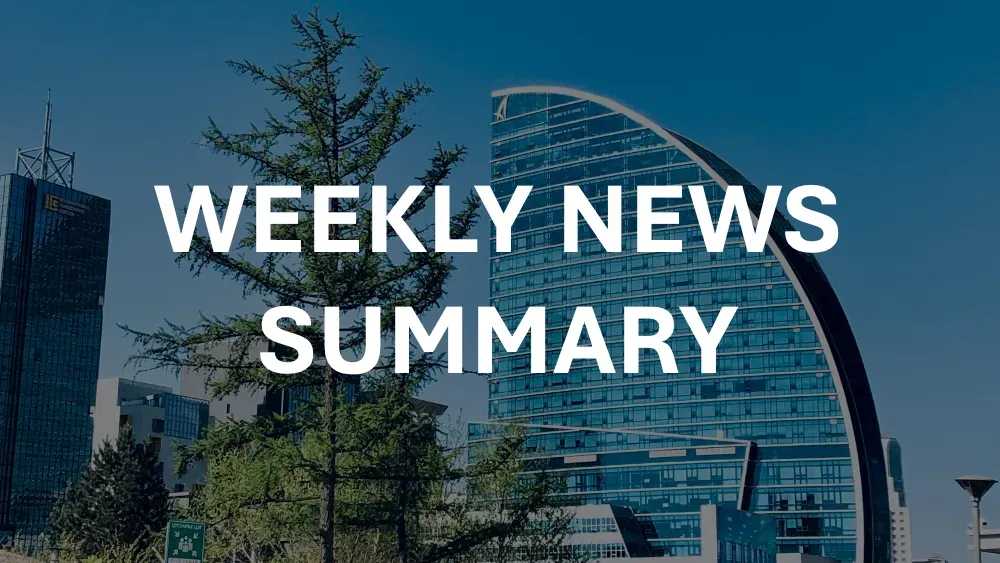
This weekly digest showcases just 10 stories. Daily subscribers receive comprehensive intelligence briefs with 40 of the top stories organized by category. Don't miss the stories that matter.
Subscribe to Daily →
November 8, 2025 to November 14, 2025
This week's top 10 stories from Mongolia, selected from our daily intelligence briefs.
1. Parliament Schedules Open Oyu Tolgoi Probe, Summons 300 Witnesses Including Former Presidents and PMs
A temporary parliamentary oversight committee has scheduled an open evidentiary hearing on the Oyu Tolgoi copper project for December 8–12 to examine state equity, licensing and financing arrangements dating back to 2006. The committee, approved by 70% of MPs and chaired by MP O. Batnairamdal, will focus December 8 on resource assessments and valuation for the “Javkhlant” and “Shivee Tolgoi” licences to determine appropriate state share, and on December 10 and 12 will probe shareholder agreements, amendments and loan interest benchmarking against global norms.
Roughly 300 witnesses — including three former presidents, seven former prime ministers, officials from key ministries and regulators, and executives from Rio Tinto, Oyu Tolgoi LLC and state firms — have been summoned; committee members say they are reviewing more than 60,000 pages of records, some classified. The Oyu Tolgoi board chair and executives missed a planned briefing and will be re-summoned, underscoring heightened scrutiny of governance and fiscal terms for one of Mongolia’s largest foreign-invested mines. MPs stress the exercise aims to gather evidence and inform the public rather than assign blame.
Local Coverage: news.mn, montsame.mn, isee.mn, ikon.mn, unuudur.mn, urug.mn, gogo.mn
From daily briefs: 2025-11-13, 2025-11-14
2. PM pushes Rio Tinto for lower Oyu Tolgoi financing costs and a Mongolian CEO
Mongolian Prime Minister G. Zandanshatar held a virtual meeting with Rio Tinto Copper chief Katy Jackson to push for lower financing costs and Mongolian leadership at the Oyu Tolgoi copper-gold mine. Both parties said they are progressing toward a principle agreement to reduce interest on project debt and cut management fees, and agreed to separate the interest-rate negotiations from licensing issues related to Ontré LLC. Zandanshatar proposed that the next Oyu Tolgoi chief executive be a Mongolian citizen nominated by Mongolia, framing the move as a governance measure to better align the joint venture with national interests.
If formalized, reduced borrowing costs would accelerate state dividend flows and ease Mongolia’s fiscal pressure from the mine, while a Mongolian CEO could reorient operational priorities toward domestic value capture and stakeholder relations. Rio Tinto signaled willingness to “work actively and closely” to turn the proposals into concrete actions; no binding deal or timetable was announced.
Local Coverage: eagle.mn, ikon.mn, itoim.mn, montsame.mn, gogo.mn, unuudur.mn, urug.mn, news.mn
From daily brief: 2025-11-13
3. Government Seeks Up to $1 Billion in New Eurobond to Refinance Costly Debt
Mongolia’s parliament has authorized the prime minister to issue up to $1 billion in foreign eurobonds in 2025 to refinance higher-cost sovereign debt, with the borrowing authority incorporated into the 2025 state budget. MP P. Sainzorig reported the country’s outstanding international bonds stood at $2.528 billion in H1 2024, including the Nomad and multiple Century tranches; the earliest maturity is the Nomad bond—₮631 billion (about $176 million)—due April 2025.
The government plans to use proceeds for liability management—swapping short‑tenor, higher‑coupon paper for longer‑tenor, lower‑cost bonds—to smooth a concentrated 2025–2027 redemption profile and reduce interest expense rather than to make direct repayments. Investors will monitor pricing, tenor and demand for the new issue and insist that proceeds be used strictly for refinancing to avoid off‑balance‑sheet slippage.
Local Coverage: eagle.mn
From daily brief: 2025-11-08
4. ADB Outlines 2025–2028 Partnership to Diversify Economy and Bolster Climate Resilience
The Asian Development Bank (ADB) outlined a 2025–2028 partnership with Mongolia to reduce commodity dependence and strengthen climate and economic resilience after resident representative Shannon Cowlin noted roughly 5% GDP growth driven by Oyu Tolgoi’s underground expansion; mining accounted for 27% of GDP and 93% of exports in 2024. The ADB plan emphasizes governance and private‑sector development, monetary‑fiscal coordination (the central bank raised the policy rate to 12% in March), rural infrastructure, access to education/health/social protection, and green finance measures—including emissions pricing, disaster early warning systems, and resilience investments—to diversify into services and agriculture and integrate rural youth through skills programs.
At an AmCham Mongolia panel on November 7, senior officials from the EBRD, ADB and the Ministry of Economy and Development and private‑sector leaders flagged steady growth forecasts (World Bank 5.6%, EBRD 5.5%, ADB 5.7% for 2026) but warned that export headwinds, inflation and political volatility constrain prospects. Panelists, including O. Adiyaa (AmCham) and Moncement CEO Tserenpiliin Khaliun, urged prompt passage and alignment of long‑pending mining, foreign investment and economic freedom laws, noting inconsistencies between the investment law and tax code and perceived preferential treatment of SOEs that undermine investor confidence.
Local Coverage: ikon.mn
From daily briefs: 2025-11-11, 2025-11-12
5. Government Sets 2026–2028 Privatization Plan; SOE Revenues Up as Lawmakers Push Governance Reforms
The cabinet will present a 2026–2028 privatization roadmap to Parliament this autumn proposing minority sales (10–51% stakes) in MIAT, the State Bank, Thermal Power Plant No.3 and state electricity distributors, alongside new bills on Public Property and State and Local State‑Owned Companies to tighten governance and transparency. Officials reported that 104 state‑owned enterprises generated MNT 26 trillion in revenue and MNT 5.8 trillion in net profit in 2024—up 10% and 15% year‑on‑year—while lawmakers flagged uneven fiscal burdens, noting Erdenet pays roughly three times the tax of Oyu Tolgoi despite similar revenues.
Policy measures being considered include expanded governance and audit requirements (including international audits) and potential steps toward public listing for Erdenes Tavan Tolgoi, reflecting a push to both monetize assets and improve accountability; the proposals, if enacted, could reshape Mongolia’s SOE landscape and investor access ahead of the 2026–2028 implementation window.
Local Coverage: gogo.mn, gogo.mn, eagle.mn, news.mn
From daily brief: 2025-11-12
6. Regulatory Maze Adds Costs and Delays for Mining Investors, Industry Group Says
Mongolia’s mining sector faces a sharply growing regulatory burden that is raising costs and delaying projects, industry group data cited by Ikon show. Investors now must navigate roughly 95 sector-relevant laws, more than 1,500 legal provisions, dozens of government resolutions and over 1,000 standards—up from an estimated 40–50 applicable laws during the Oyu Tolgoi negotiations—adding complexity for foreign entrants who typically screen only core statutes (Investment, Minerals, Land, Water). A mid‑sized primary gold project may require about 280 permits and permit‑like documents during construction, and even routine permitting phases can take up to two years when processes run smoothly.
The cumulative effect—long exploration lead times (often 10–20 years without revenue), sequencing constraints and prolonged permitting—inflates sunk costs and erodes both project and fiscal returns. The Züvch‑Ovoo project illustrates the risk: it spent some 25 years in exploration before moving to development. For international investors and policy analysts, these specifics signal higher entry barriers, elevated risk premia and the need for targeted regulatory streamlining or clearer sequencing to preserve investment attractiveness.
Local Coverage: ikon.mn
From daily brief: 2025-11-11
7. Harvest Output Falls 40% as Drought and Extreme Heat Hit Crop Yields
Mongolia’s 2025 crop harvest is forecast at 745,100 tonnes, a 40.3% year‑on‑year decline, Health, Agriculture and Light Industry Minister J. Enkhbayar reported. Breakdowns show 274,100 t of grain, 101,900 t of potatoes, 208,600 t of vegetables, 133,300 t of fodder and 27,200 t of oilseeds; year‑on‑year falls include wheat −34.7%, potatoes −22.9%, vegetables −22.0%, fodder −46% and oilseeds −49%. Authorities attribute the collapse primarily to extreme weather between May and July — scant rainfall, air temperatures peaking at 37–39.5°C and soil surface temperatures of 65–69.6°C, plus prolonged 40°C+ days and episodic heavy rain and hail — although improved conditions in August–September raised wheat quality and accelerated harvesting.
The shortfall has material implications for domestic food security and market balance: current coverage estimates are 62.5% for wheat, 76.9% for potatoes and 72.6% for vegetables, signaling likely increased imports or price pressure and stress on livestock feed supplies given the 46% drop in fodder. Policymakers and international stakeholders should weigh targeted import, storage and relief measures as well as investments in climate‑resilient cropping, irrigation and early‑warning systems to mitigate similar shocks.
Local Coverage: montsame.mn
From daily brief: 2025-11-08
8. Cross-Border Rail Links Reviewed as Government Targets Export Surge and Logistics Hub Ambitions
Mongolia’s cabinet reviewed progress on strategic cross‑border rail projects aimed at expanding links with China, including Gashuunsukhait–Gantsmod, Hangi–Mandal, Shivee Khuren–Sekhe and the eastern vertical corridor Ereentsav–Choibalsan–Bichigt. Transport Minister B. Delgersaikhan reported timelines and expected outcomes for the network, which is designed to raise annual freight capacity to 60–70 million tonnes and boost export revenues by an estimated US$2–3 billion, potentially adding roughly 1.5 percentage points to GDP growth.
Officials argue the upgrades will strengthen border throughput, support more balanced regional development and position Mongolia as a northeast Asian logistics hub and transit node integrated with Chinese gateways and regional supply chains. The plan targets increased coal and mineral exports and improved multimodal east–west and north–south connectivity, with implications for trade flows, transit competition and investment in supporting infrastructure.
Local Coverage: montsame.mn, ikon.mn, eagle.mn
From daily brief: 2025-11-13
9. Government Unveils Five-Year Plan to Shield Household Incomes with Tax Cuts and Privatization Push
The government unveiled a five-year economic agenda aimed at shielding household incomes and accelerating structural diversification away from raw commodity dependence through tax reform, privatization, and large-scale industrial projects. The package proposes corporate, personal income and VAT changes designed to cut taxpayer burdens by MNT 3–4 trillion, including raising VAT refunds on monthly purchases up to MNT 1 million from 2% to 5% (increasing quarterly per‑person refunds from ~MNT 50,000 to ~MNT 125,000). It also foresees partial listings of state assets (MIAT, Törin Bank, Thermal Power Plant No. 3), AI‑enabled procurement and SOE oversight, and a tax/amendment push to favor value‑added production.
Policy priorities target energy, tax and agriculture reforms and rapid build‑out of processing capacity to become export‑oriented: commissioning copper smelting (target 560,000 t/y), a 1,000,000 t/y iron plant, and oil refining and related projects by 2027–2028, plus power additions to reach ~4,168 MW and support for renewables. The plan leans on recent macro momentum—stronger fiscal balance, improved balance of payments, a firmer tugrik, higher FX reserves and rating outlook upgrades from S&P, Moody’s and Fitch—to justify timelines (refinery ~50% complete) and attract investment into downstream copper, coal, oil and light‑industry (wool, cashmere, leather) expansion.
Local Coverage: ikon.mn
From daily briefs: 2025-11-11, 2025-11-14
10. Energy Resources, China Energy Set 2026 Coking Coal Volumes and Pricing Framework
Mongolia’s Energy Resources LLC and China Energy finalized volumes and a market-based pricing framework for 2026 coking coal deliveries under their decade-long strategic partnership, agreeing at the China International Import Expo in Shanghai that Energy Resources will supply up to 4.9 million tonnes of washed hard coking coal and 1.0 million tonnes of washed semi-soft coking coal next year, priced at prevailing market rates. The arrangement was formalized via a supplementary contract and builds on their 2018 cooperation across coal trading and logistics.
The deal reinforces cross-border supply security for China’s steel sector and leverages infrastructure investments: the partners co‑funded a bonded transshipment and storage hub at Gantsmod in 2021 with a 7 million‑ton annual receiving capacity, and China Energy is leading completion of the Gashuunsukhait–Gantsmod rail link this year. Together, these steps are poised to expand throughput, lower transport costs and improve delivery predictability along the Mongolia–China corridor.
Local Coverage: montsame.mn, itoim.mn, ikon.mn
From daily briefs: 2025-11-11, 2025-11-12
About This Weekly Digest
The stories above represent the most significant developments from Mongolia this week, selected through our AI-powered analysis of hundreds of local news articles.
Stories are drawn from our daily intelligence briefs, which synthesize reporting from Mongolia's leading news sources to provide comprehensive situational awareness for international decision-makers.
These weekly highlights are a small sample of what's happening. Daily subscribers get comprehensive briefings with 40 top stories that connect the dots between events, track developing stories, and provide the context you need for informed decision-making.
Upgrade to Daily →